

I arrived in Bishkek early on a July morning.
The sun was still slanting, softened by the summer haze hanging over the Kyrgyz capital.
It is not the kind of first impression we usually have with cities close to our imagination. But I already knew that. And in truth, it is exactly what I was looking for.
The thirty-minute van ride from the airport to the first place where I could rest after the long flight was already telling me something:
I would often witness the contrast between a slow, nomadic, traditional rhythm and a tendency, almost a tension, toward modernity and all its compromises.
In these notes on what to see in Bishkek, the capital of Kyrgyzstan, I will try to free myself as much as possible from the weight of my Italian and European imagination, and instead listen, through the city itself, to the stories of a part of the world about which we know almost nothing.
If you are willing to do yourself the same favor, welcome to Bishkek.
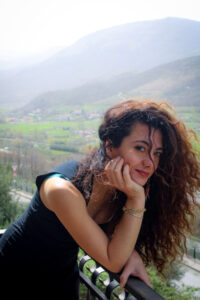
I’m Sabrina, independent blogger.
I tell stories about destinations in a very political way.
If this approach resonates with you, intrigues you, or feels familiar,
Ala-Too Square: The Symbolic Heart of Bishkek
I find it incredibly meaningful – both for telling the story of the city and perhaps of the entire country – that the central square, the symbolic heart of Bishkek, is framed by Kiev, Pushkin, Razzakov, and Panfilov streets.
In every post-Soviet city there is a square that more than any other preserves the traces of power, change, and revolt. In Bishkek, that square is Ala-Too.
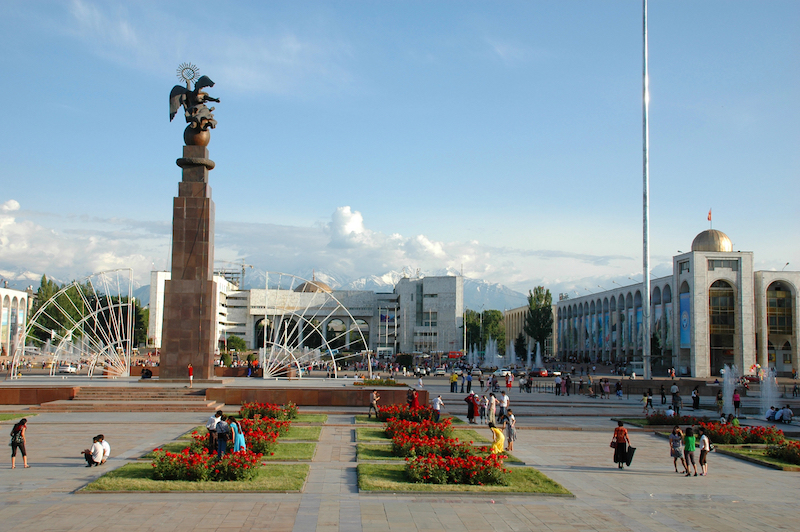
piazza Ala-Too | depositphotos.com
They used to call it Lenin Square. Today, at its center, stands the statue of Manas, the national epic hero, symbol of strength, courage and, above all, identity.
He was chosen in 2004 to replace the statue of the former Soviet leader, almost as if the narrative of power was being rewritten, from conqueror to legendary founding father.
Lenin’s statue, however, was neither demolished nor destroyed, certainly not erased. But we will come back to that in a moment.
Near Manas, an extremely tall flagpole holds the Kyrgyz flag, rich in symbols that tell the story of the country:
- its legendary 40 tribes (the forty rays) and the central motif recalling the roof opening of a yurt.
- The flag was designed in 1992, immediately after independence from Russia.
- The yurt also appears, stylized in bronze, in the Victory Monument, with its eternal flame dedicated to those who died for freedom and independence.
It may not be a “beautiful” square according to our common aesthetic standards, but it is dense with symbols. It feels tense. It almost shouts in order to reclaim traditions, the past, and an identity that had long been suppressed.
It is a place of national reconciliation, and yet it is also here that, in March 2005, thousands of people gathered to overthrow President Akayev during the so-called Tulip Revolution, sparked by allegations of electoral fraud, corruption, and violence carried out by the president and his family.
It was also here that the 2010 anti-corruption protests and demonstrations against authoritarian drift took place, eventually leading to a new constitution, though sadly after hundreds of deaths.
A monument in the square is dedicated to them: yet another neoclassical symbol of Bishkek’s complicated political memory.
The State History Museum and Lenin’s Statue
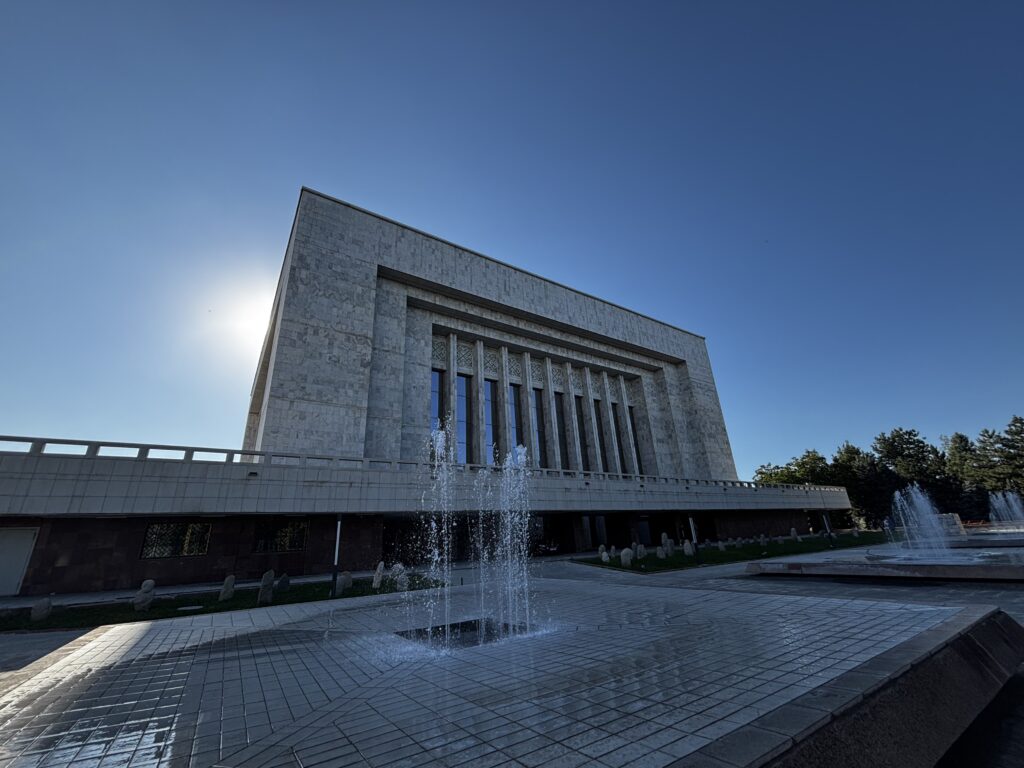
Facing Ala-Too Square, the State History Museum of Kyrgyzstan rises like an imposing block of marble and silence.
From the outside it looks almost like a shrine to Soviet ideology: rigid lines, monumental severity, large unadorned glass surfaces. Inside, it represents a leap into official historical narrative, and into the way a country reinterprets and celebrates its past while attempting to build its future.
The entire history of the nation is told here, from ancient myths and national heroes (whom I will talk about soon, because they deserve deeper attention), to contemporary international relations.
The exhibition moves through the Tsarist period, the Soviet era, and the rich culture of nomadic clothing and traditions, breathtakingly beautiful.
It is precisely in the contrast between the static museum displays and the vibrant life of the square outside that one can grasp both the fracture and the continuity of Kyrgyz history.
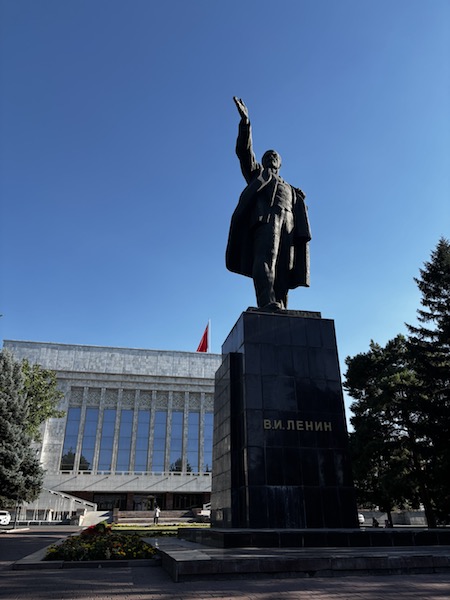
And then, there he is. Vladimir Ilyich Lenin, sculpted with firm lines and placed in 1984 in a dominant position in the square behind the museum and Ala-Too.
When the statue was first installed, the gesture was rhetorically symbolic. Today, its position is symbolic in a different way. It seems almost to look suspiciously toward the City Hall building.
No longer facing the people, but power.
Considering the effort to reassert a national identity that had long been suppressed by Russia, and considering the persecutions of nomadic culture during both the Tsarist and Soviet empires… Why is there still a statue of Lenin in such a central place in Bishkek?
And why is Russian still an official language, and until recently even the primary language taught in schools?
The relations between Kyrgyzstan and Russia have never truly been hostile or distant, even after independence.
A large portion of the country’s GDP still depends on remittances sent by Kyrgyz migrants working in Russia.
When fragile governments collapse, political leaders often seek refuge in Russia or Belarus.
And considering the official, and increasingly unofficial, trade relations between the two countries, it is politically convenient that historical changes be narrated as soft transitions through time rather than sharp breaks.
The White House of a Young Democracy
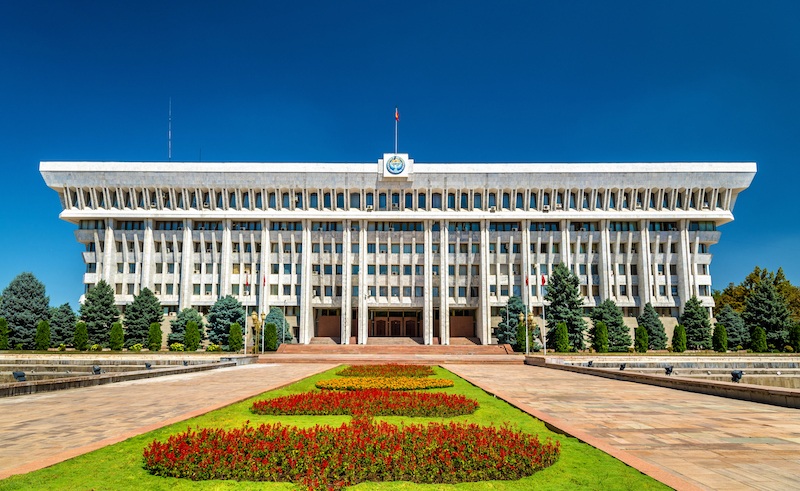
depositphoto.it
The White House of Bishkek stands imposing beside Ala-Too Square.
Its severe white-marble façade looks as if it came straight out of a Soviet architecture manual.
Home to the Kyrgyz government, it is both an institutional symbol and a silent witness to the revolutions that have shaken the country.
Its granite-like appearance, almost impenetrable, contrasts sharply with the lively square in front of it, a place where protests, revolts, and celebrations have repeatedly unfolded.
The building itself cannot be visited inside, but it remains one of the most meaningful places to understand how political power in Kyrgyzstan can never truly be separated from the urban landscape.
Panfilov Park
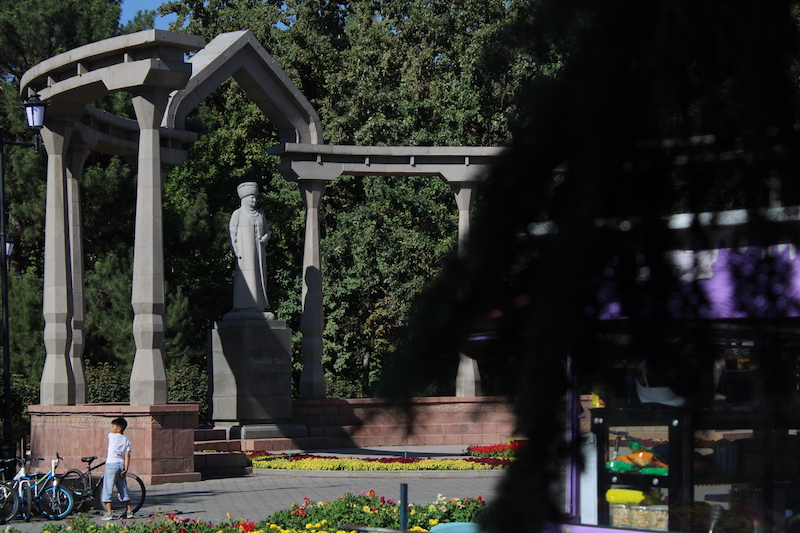
If Ala-Too Square tells the story of power, Panfilov Park tells the story of everyday life.
Under the dense canopy of lime trees and walnut trees, this large city park hosts the slow pauses of the capital: children on slightly retro amusement rides, students chatting in the shade, men playing chess as if it were a secular ritual.
As you walk through the park, you encounter statues that speak of identity and memory.
Among them is the statue of Kurmanjan Datka, the “Queen of the South”, a symbol of resistance and political intelligence in a historically patriarchal land.
Thanks in part to figures like hers, new generations of Kyrgyz people are able to rebuild a sense of identity that feels both rooted and proud.
Osh Bazaar: Legacy of the Silk Road
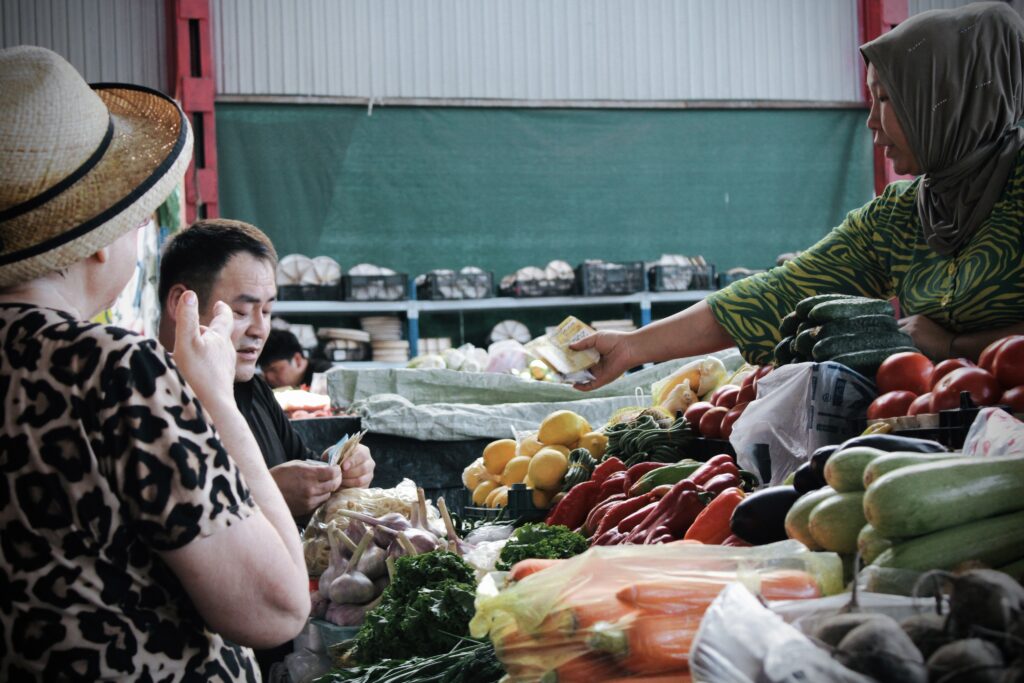
Bishkek, mercato di Osh | ph SabrinaBarbante
Osh is the name of a city in southern Kyrgyzstan, in a region squeezed between Uzbekistan and China.
It was a key city along the Silk Road.
Here in the north, in Bishkek, the goods that once made Central Asia the center of the global economy often arrived from Osh. That is why the main historic bazaar of the capital still bears its name.
The beauty of the spice stalls and their incredible variety blends with the colorful vitality of the merchants.
Women bargaining, women cutting flowers, young girls packing dried fruit, men selling tobacco, elderly women checking notifications on their phones with wallet-style cases.
Everything that moves through the capital of Kyrgyzstan passes through this market every day.
Kumis: A Piece of Nomadic Economy

Ph. Isabella Bradascio
In the streets of the city, on secondary dirt roads, and certainly at the entrances of every market, including Osh Bazaar, you will find Kyrgyz vendors behind rudimentary stands.
Usually there are two containers, one blue and one red, shaded by umbrellas.
These people sell kumis qɯmɯ́z, a Central Asian drink that is a fundamental part of Kyrgyz nomadic culture.
It is fermented mare’s milk, slightly alcoholic and surprisingly refreshing.
The Old “Brutalist” Central Mosque
Hidden among the less visited streets of the city center, in a side street off Gogol Street, the Old Central Mosque of Bishkek is one of the oldest places of worship in the capital.
Built in 1886 and restored in the late twentieth century, it was for many years simply known as “the central mosque”, until that title recently passed to the new and spectacular mosque of the city.
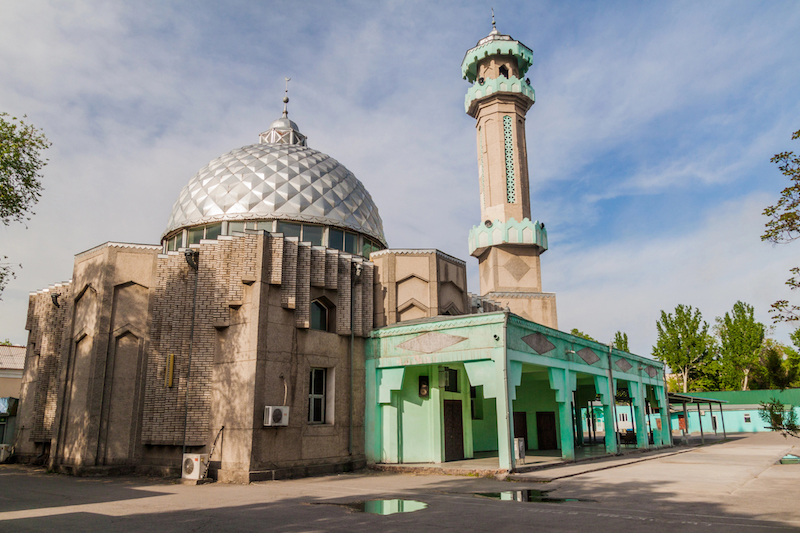
vecchia moschea centrale, Bishkek, kirgizistan – depositphoto.it
It is a discreet but spacious complex, with architectural elements reminiscent of brutalism, containing three halls for collective prayer. The largest hall can host more than 600 worshippers, while another holds around 1,000.
But on Fridays, the sacred day of prayer, the numbers grow dramatically: between interior spaces and courtyards, more than 5,000 people gather here.
The New Blue Mosque of Bishkek
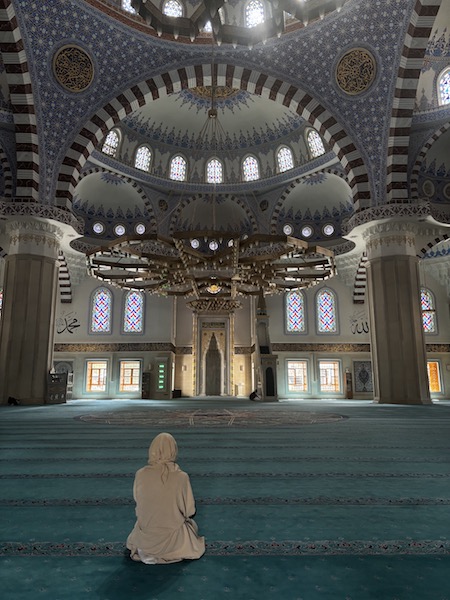
Many call it “the Blue Mosque of Bishkek”, because of its architectural resemblance to the one in Istanbul. Its official name, however, is the Imam Serahsi Mosque, and its visual impact is anything but discreet.
Financed and donated by Turkey, it was inaugurated in 2018 and represents far more than a place of worship. It is a symbolic gesture of religious proximity, certainly, but also a geopolitical statement.
Turkey is investing in cultural and spiritual influence in Central Asia, strengthening ties with Turkic peoples such as the Kyrgyz.
Among other initiatives, Erdogan’s Turkey funds private universities in Kyrgyzstan, offering many scholarships, provided students speak Turkish, thus encouraging the spread of the Turkish language throughout Central Asia.
The mosque can host up to 20,000 worshippers, dominating the skyline with its blue domes, towering minarets, and an aesthetic that directly recalls Ottoman grandeur.
The National Opera and Ballet Theatre
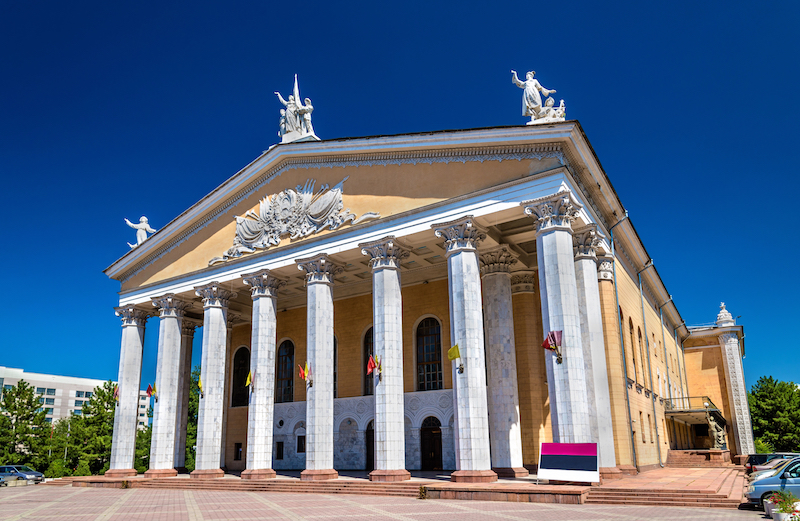
ph. depositphoto.it
Among the wide avenues and architectural blocks inherited from the USSR, the National Opera and Ballet Theatre of Bishkek appears like a monument to Soviet classicism: columns, symmetry, pale marble.
Yet behind that severe façade beats a vibrant and deeply Kyrgyz artistic scene.
Built in 1955, it was for decades one of the cultural hearts of the Kyrgyz Soviet Socialist Republic.
Today its program alternates Russian repertoire, great European classics, and works inspired by nomadic traditions and Kyrgyz epic poetry.
Between the still-visible Soviet legacy, parks full of families and chessboards, mosques telling stories of faith and politics, and markets scented with spices and ancient fermentations, Bishkek is not a city that reveals itself on the surface.
It is not the glossy postcard of Central Asia.
Here you walk among symbols and contradictions, balanced between memory and transformation.
Like the nomadic bodies of its horse-riding athletes, Bishkek is still searching for its balance.
And to those who look at it with open eyes, it offers far more than it promises.





Lascia un commento